News
openRxiv Day: envisioning scientific communication as a connected ecosystem
By Richard Sever (Chief Science & Strategy Officer) and Tracy K. Teal (Chief Executive Officer)
Gathering together scientists, technology experts, funders, and representatives of various non-profit organizations, the Open Science meeting organized by the Chan Zuckerberg Initiative (CZI) has been an inspirational conference for several years. It is a great forum for exchange of ideas and has spawned many collaborations and new initiatives. This year’s conference was unique in that it coincided with the launch of openRxiv and featured an additional satellite meeting celebrating openRxiv and the success of our preprint servers bioRxiv and medRxiv.
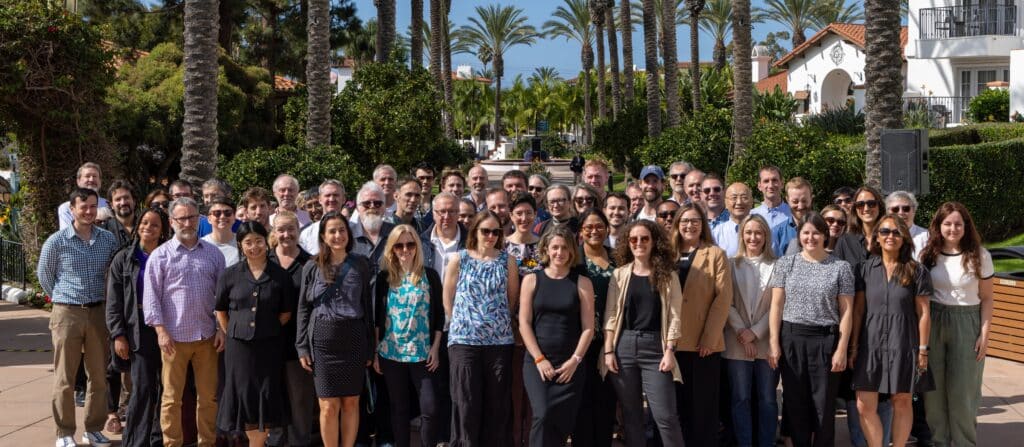
The openRxiv day provided an opportunity to lay out our vision for the future and bring together members of the community to examine how we can work together with other organizations to improve scientific communication. In our opening address, we (Richard Sever, Tracy Teal, and John Inglis) made the case that with the creation of openRxiv we are now at a point where we can use the full potential of the Web to achieve this. The bioRxiv and medRxiv servers have already demonstrated that decoupling of dissemination of scientific findings from their formal evaluation by peer review can speed up science—most obviously during the pandemic, when preprint sharing saved lives and accelerated the scientific response to the SARS-CoV-2 virus. With >380,000 preprints deposited on bioRxiv and medRxiv, early sharing of results is being embraced by the life science and biomedical communities, and there is an opportunity to consider what articles and the broader ecosystem they inhabit should ultimately look like.
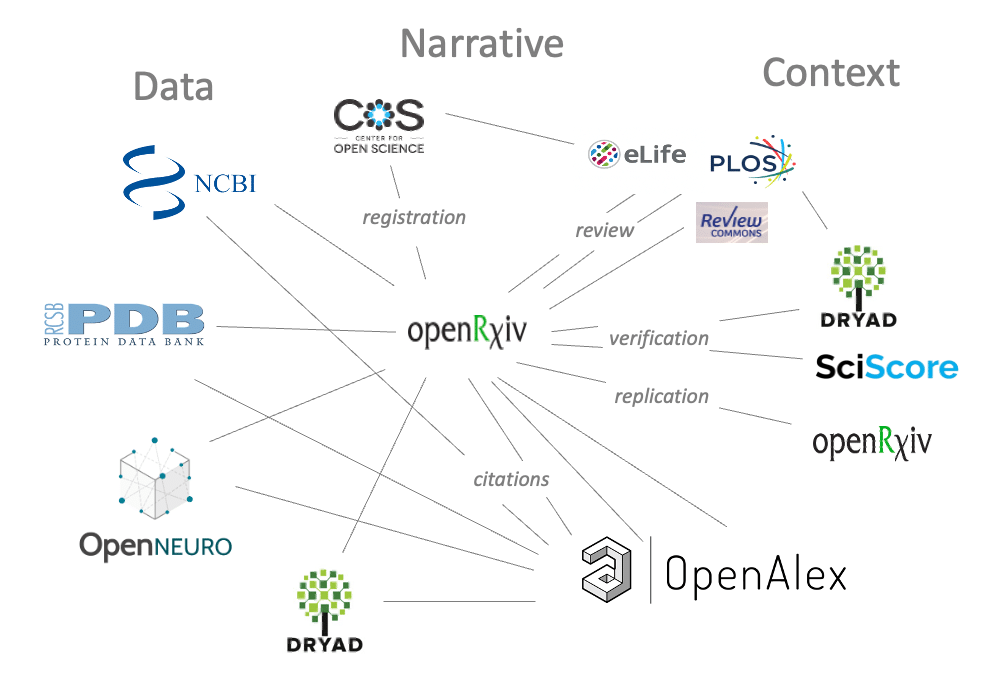
The ‘article of the future’ is often reimagined as a radically different object with embedded data, associated coding environments, plus myriad other new features. These are possibilities that we will be exploring with a new openRxiv-labs project, but it is important to stress that articles do not exist in isolation. Much of the underlying data resides in repositories with highly domain-specific functionality that could not be replicated by a preprint server (let alone in a standard portable document), and there are numerous other critical outputs relating to an article that reside elsewhere. A constellation of linked web objects is therefore a better model for the article of the future and would reflect Tim Berners-Lee’s original vision of the Web. In this model, a narrative (the article) is seamlessly linked to upstream registration events, supporting data/code in appropriate repositories, and downstream replications, citations, reviews and other evaluations.
The constellation model also underscores the fact that articles are just one of a number of different research outputs, rather than the sole currency of scientific productivity. These outputs are decoupled and stewarded by independent groups that operate peer review and verification services, databases, code archives, and literature-indexing and -discovery tools. The constellation can therefore also be envisaged as a network of organizations that work together. Our goal is for openRxiv to be a critical node in this network, partnering with other organizations to disseminate science, make it discoverable, and provide context and trust signals for readers.
This vision was widely reflected in talks and breakout sessions at the openRxiv meeting, which showed how we are working with different organizations to achieve it by emphasizing interoperability and collaboration. In her talk, Emma Croushore from openRxiv demonstrated how the openRxiv dashboard already uses tools like Hypothes.is to embed and/or link to content and trust signals from a variety of different sources. Peer reviews from journals and other review services, for example, can be displayed alongside articles on bioRxiv and medRxiv using the dashboard. Daniela Saderi from PREreview and Brook Runette from SolvingForScience presented details of their organizations’ efforts to broaden participation in peer review and break it down into quality/impact analyses, respectively. Meanwhile, in his wide-ranging keynote, Oded Rechavi introduced q.e.d science, an author-centered AI review platform that openRxiv is partnering with. John Inglis from Cold Spring Harbor Laboratory Press and Thomas Lemberger from EMBO Press continued the discussion of review and curation by examining the variety of ways traditional peer review venues can engage with preprints.
Information verification is becoming an increasingly essential complement to peer review. Anita Bandrowski from Sciscore showed how they are extracting resource and reagent IDs (RRIDs) to create human- and machine-readable tables to provide additional trust signals alongside preprints, while Maria Maria Guerreiro from Dryad outlined their collaboration with openRxiv to curate data deposits. Kevin-John Black from openRxiv described pipelines that enable interoperability of bioRxiv/medRxiv with journals and other author services. Rowan Cockett from Curvenote extended the technological vision to outline how articles might evolve to become more interactive and feature better representations of the underlying data.
Other sessions at the meeting covered some of the challenges the ecosystem is currently facing. Olaya Fernandez-Gayol and Sanchari Ghosh from openRxiv led a discussion with Theo Bloom from BMJ, Veronique Kiermer from PLOS and Steinn Siggurdson from arXiv on the difficulty of screening submissions for fraudulent papers at a time when large language models (LLMs) are making it increasingly easy for paper mills and other bad actors to generate these. Monica Granados and Taylor Campbell from Creative Commons continued on the theme of AI, convening a breakout group including Kirsty Whitaker from the Berkeley Institute for Data Science focused on how this may affect preprint adoption and reuse. In neither case are there any easy answers, and Steinn emphasized the potential existential threat that generative AI poses to information verification and filtering and the need for a concerted effort by the whole community to address this.
Many of these issues manifest because of perverse incentives in academia, in particular its publish-or-perish culture. With this in mind, Daniela and Vanessa Fairhurst from PREreview and Katie Corker from ASAPbio hosted a breakout session looking at how academic evaluation may be improved. Public commenting is something that would help readers evaluate work but there are currently low levels of this on preprint servers. Samantha Hindle and Martina Proietti from openRxiv discussed ways to incentivize this further in the session they hosted. Public communication comes with its own pitfalls, and Jamie Grabert and Debbie Gunning from The Consultancy Group provided advice on maintaining credibility in public communication at a crucial time in science.
It was great to see so many dynamic conversations happening at the meeting as new and old colleagues converged around ideas and vigorously debated the best way forward. We’re so grateful to the CZI Open Science and Meetings teams, who created the opportunity for this meeting and handled the logistics that made it such a success. A spirit of collaboration was evident throughout, and a feature of many of the discussions was the idea that openRxiv could be a trusted non-profit steward for initiatives that is governed by and acts in the interests of the scientific community, as a values-led organization. We want to help create and sustain communities, promote scientific communication globally, and continue the fantastic work our incredible in-house team and all our partners have done together so far. The openRxiv Day gave everyone a sense of the progress we have made and what is to come. We look forward to building that future with you.