News
Preprints as research record: our roadmap
A convergence of social, economic, and technological forces is creating a unique opportunity to re-envision how we share and use research. openRxiv aims to transform the preprint from a static manuscript into a structured, reusable research record connecting narrative, data, code, protocols, figures, reviews, provenance, and trust signals in an open Corpus that people and machines can use to accelerate trustworthy science.
bioRxiv began this process in 2013 by unbinding dissemination of research from its evaluation, allowing researchers in the life sciences to start distributing their work the moment they are ready to share it, rather than waiting months or years. Since then, biomedical preprinting has grown from a niche activity of a few dozen preprints per month to a broadly accepted practice with over 6,000 submissions per month at bioRxiv and medRxiv alone. This growth in usage, combined with the demonstrated impact of researchers building on each other’s work to produce breakthroughs at once-unthinkable speeds, particularly during the COVID-19 pandemic, has proven the value of preprinting.
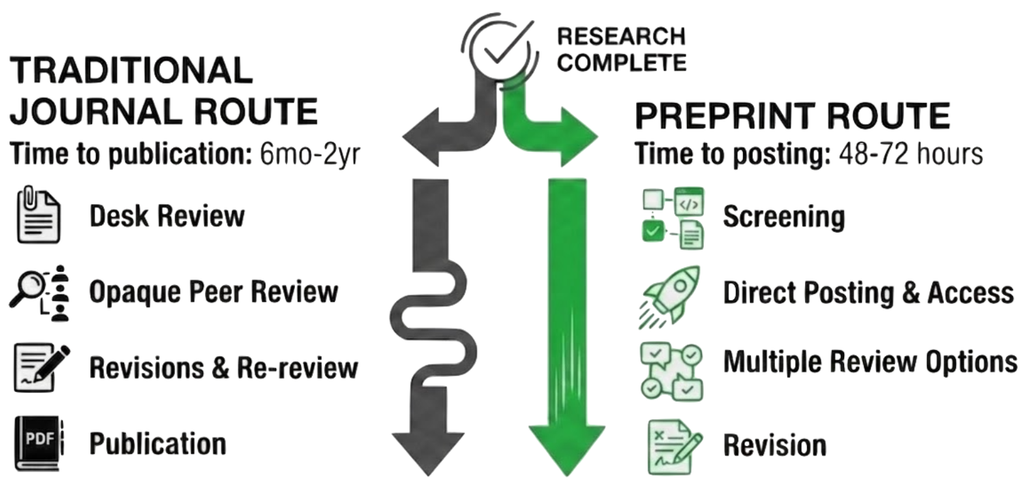
We now have the opportunity to continue this process by redefining preprinting as the process of sharing not just a narrative summary of research, but the full record of research that went into the manuscript. We believe this opportunity is worth pursuing because we’ve heard from you — the researchers, librarians, readers, technologists, policymakers, and funders who make up our community — that you’re ready for preprints to provide even more benefits. You’re looking for data, code, images, protocols, reagents, research materials, resources, and software packages that you can easily evaluate and make use of in new workbench and coding tools. You want to know when other people do the same for your work, so you can get credit for your research contributions when they’re actually used, not just when your articles are cited. And you want to take advantage of this wealth of information to find relevant research using new discovery tools, using signals of trust and review that help you understand, evaluate, and build on others’ research more effectively.
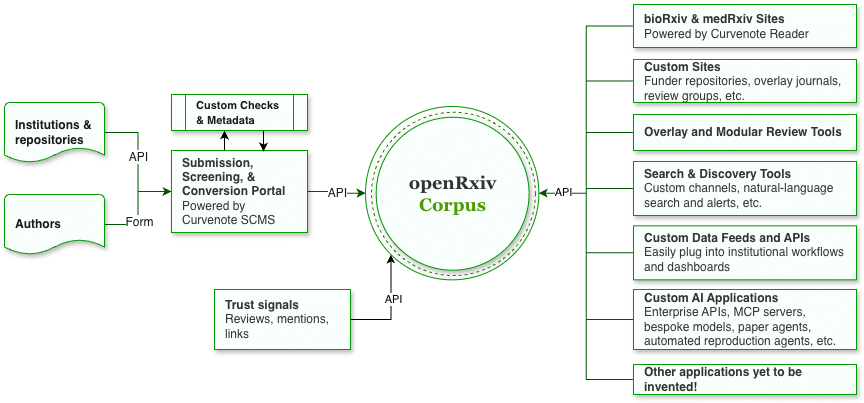
To realize this opportunity, openRxiv will evolve the bioRxiv and medRxiv preprint servers from websites displaying HTML and PDF documents to platforms for sharing, analyzing, and reusing structured research outputs. We will provide tools to help authors seamlessly enhance their narratives with rich connections to data, code, and other resources. Once screened, these structured preprints will become part of a public openRxiv Corpus that human and machine readers can access, analyse, and build on top of in ways that align with the author’s chosen license, our values, and our approach to AI. Preprints will become the easiest and most comprehensive way for researchers to share, find, evaluate, and reuse not just the narrative description of an experiment, but the science at the foundation of the publication — so that each discovery can spark the next.
Preprints: The Science at the Foundation of the Publication
Sharing manuscripts prior to formal peer review uncouples dissemination from evaluation, allowing researchers to build on each other’s work without waiting for a formal stamp of approval. The platform we’re building will continue this trend, unbinding the narrative manuscript from the figures, protocols, data, math, code, resources, and pipelines that went into the experiments the manuscript describes.
Too often, manuscripts don’t provide the full record of the science behind the descriptive narrative. Incomplete records result in friction that impedes science by limiting the analyses that are possible and requiring researchers to waste time tracing or asking for data or code.
This friction generally isn’t researchers’ fault. Limitations of submission interfaces and lack of coordination, guidance, and standards have made it difficult to package and access the full record of the science behind an experiment. Meanwhile, the effort required to learn and use others’ code, data structures, and pipelines and find them in the various repositories has meant that even when these resources are provided, they are rarely re-used in future works, giving researchers little incentive to put in the effort.
These realities are changing. The community is implementing new, modern standards that allow researchers to create more complete records of their work without changing their research and authoring practices. AI-driven coding agents and other new tools are making it possible to find relevant work, assess its quality, and reuse code and data far more quickly and seamlessly than before. Funders and institutions are experimenting with new ways of thinking about and evaluating the impact of research. What’s missing is the scaled infrastructure required to make sharing a more complete record of the research process and its outputs the default choice for researchers globally.
The future of the preprint is human- and machine-accessible records of the science at the foundation of the publication, built on open standards, and made instantly discoverable across the globe for researchers to evaluate, replicate and build on.
We welcome you to join us in building this future together.
Get Involved
This post outlines our vision and initial high-level plan for achieving it. It is intended as a starting point for conversation, reflection, and action. If you’re interested in getting involved, we are seeking input in several ways. We welcome anyone to send a note to hello@openrxiv.org, or mention us on Bluesky. If you are a bioRxiv or medRxiv user, we are creating a user panel to provide early feedback on and testing of new features. To sign up for our user panel, please fill out this short form.
Roadmap: From Website to Corpus
Achieving our vision within this critical window of opportunity will require balancing the need to move quickly and decisively with the imperative to include and understand community needs and feedback. In developing our vision and roadmap, we consulted with science funders, builders, infrastructure providers, publishers, and researchers across the ecosystem. We considered numerous funding policies and reports, landscape analyses, and infrastructure repositories in our analyses, and engaged in several pilots to test some of the most important technical aspects of our thesis.
The result of this process is a three-stage plan to overhaul our infrastructure to provide the tools for submitting and enhancing structured preprints, screening them at scale, and distributing them to human and machine readers and builders via next-generation interfaces. We have already begun this transition with key partners, including through experiments in openRxiv Labs, and expect to complete the first iteration of it by the end of 2027. What follows is a high-level roadmap of how we plan to achieve this vision. Over time, we will add a dedicated roadmap page with more detail, progress and changes as development evolves, and further opportunities for giving feedback and getting involved in testing and contributing.
Phase 1: Content Structure & Reading Experience
In progress. Estimated initial launch: January 2027
This phase is focused on developing the capability to create structured research outputs from any source format without requiring additional work on the part of authors, while enabling additional features for submitters who do want to enhance their preprints with interactive and easier-to-replicate features. We began this process with Curvenote Reader in June 2026 as our first openRxiv Labs experiment, and have seen almost universally positive qualitative feedback in addition to impressive adoption, as detailed in our openRxiv Labs blog series.
Projects
- Conversion of the entire openRxiv Corpus to a prototype version of the Open Exchange Architecture format with minimal errors and no author input required [Completed]
- openRxiv Labs Curvenote Reader front-end [Completed]
- Native display of third-party reviews and other trust signals in the openRxiv Labs Curvenote Reader experience [In progress]
Target Outcomes
- Sub-1% error rate as a result of the OXA conversion process
- Positive qualitative and quantitative feedback on the new reading experience
- Community alignment around new, modern formats for research outputs that are adopted by openRxiv and additional partners
Phase 2: Screening & Submission
In progress. Estimated initial launch: June 2027
This phase is focused on developing two key capabilities. First, we will offer an AI-enhanced submission portal that seamlessly converts a submission from common formats to the emerging community-led Open Exchange Architecture format, and makes it easy for authors to improve their preprints by checking them against best practices and funder policies and suggesting ways to add additional metadata, structure, materials, and links to resources like code, data, protocols, reagents, and other resources. Second, we will employ a screening tool that uses this additional structure and metadata to assist screeners and meaningfully improve both the quality and efficiency of our screening processes, aligned with our values and AI usage policies. As part of this phase, we will work with other preprint servers, journals, and tool-builders to co-develop tools for automating common screening tasks so that the ecosystem as a whole can increase its capacity to screen and post preprints in the face of an increasing number of submissions.
Projects
- AI-enhanced submission portal [In Development]
- Screening module [In Development]
- Screening checks [In Development]
- openRxiv authentication provider [Expected]
Target Outcomes
- Increased author satisfaction compared with the current submission process, while producing more complete and compliant structured preprints
- Less time spent screening each submission, with higher levels of accuracy
- Preprint server community alignment around sharing code, best practices, and other resources for common screening checks, with at least one external partner submitting a check, and one external partner using one they did not submit
Phase 3: Corpus, Discovery, and Impact
Starting Q4 2026. Estimated initial launch: November 2027
This phase is focused on building the infrastructure required to replace our current systems with production versions of the pilot infrastructure built in phases 1 and 2. Specifically, in this phase we will transition our main content database to an openRxiv Corpus accessible to all via enterprise-grade APIs, and then harden our submission, screening, and front-end pilots to production-ready systems that submit to and read from the Corpus via the same public APIs.
Projects
- openRxiv Labs search & discovery experiment [In Planning]
- Institutional channels/dashboard redevelopment [In Progress]
- Corpus API development and launch [Expected]
- Design and launch permanent new bioRxiv and medRxiv front-end [Expected]
- Transition front-end and submission/screening from internal database to public openRxiv Corpus APIs [Expected]
Target Outcomes
- Improvement in visits, submissions, and author and reader satisfaction within 3 months of full transition
- Success stories of faster, more efficient reuse of underlying science within structured preprints to demonstrate early impact
- Development of at least one value-added impact measurement service on top of the openRxiv Corpus, with positive feedback from institutions
- Increased institutional support for openRxiv within 6 months of transition
- Interest from other institutions or builders in adopting openRxiv’s methodology, tools, or Corpus