News
A new automated feedback option for authors
Authors who post preprints on openRxiv servers can get formal and informal feedback on their manuscripts in a number of ways. Our bioRxiv to journal (B2J) and medRxiv to journal (M2J) pipelines are linked to traditional peer review venues, enabling authors to save time by submitting directly from bioRxiv or medRxiv to any one of more than 300 journals and independent peer review services. In addition we integrate with a variety of community review projects and provide on-site commenting. We are also adding automated review services as an option for authors, which may become increasingly popular as authors seek additional ways to receive timely feedback alongside traditional peer review.
Today we’re announcing a new automated service to the options for authors: Reviewer3. Reviewer3 is an AI review service that can provide authors with a comprehensive technical review of their manuscript within minutes. It is a multi-agent system built specifically for science that aims to separate technical review from assessment of the importance of the work, which is left to humans. You can learn more about Reviewer3 on their website and in their recent blogpost about the collaboration.
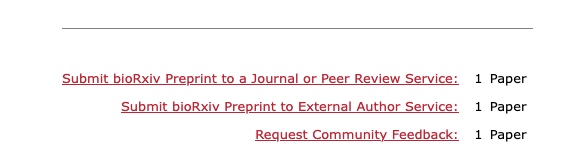
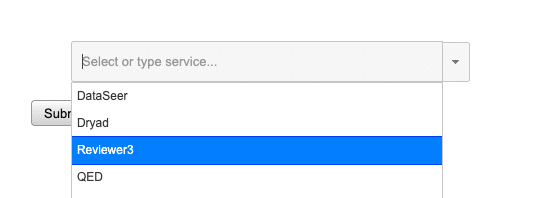
For an author to utilize Reviewer3, they submit a paper to bioRxiv, then return to their Author Area, and select “Submit Preprint to External Author Service”. Reviewer3 appears as an option alongside each of their manuscripts. The service is currently available only on bioRxiv. Just like B2J and other external services connected by the B2X/M2X pipelines, it is simply an option authors can select that is intended to save them time with downstream review activities, if they are interested in taking advantage of an optional integrated service. Reviewer3 outputs are generated by an external service and should be treated as author-facing feedback.
As additional automated tools are developed by the community, we will also be offering these to authors. The decoupling of dissemination from review that preprints afford is prompting evolution of the review process and providing many new opportunities for authors to get feedback on their work. We will continue to facilitate experiments of this type, taking advantage of new technology to improve the authoring and reading experience.